
Cyber threats are evolving faster than ever. Organizations of all sizes face risks from ransomware, phishing attacks, data breaches, insider threats, and application vulnerabilities. Unfortunately, many businesses only discover security weaknesses after a cyber incident occurs.
This is where Vulnerability Assessment and Penetration Testing (VAPT) becomes essential.
VAPT helps organizations identify, assess, and remediate security vulnerabilities before attackers can exploit them. It provides a proactive approach to cybersecurity by combining automated vulnerability scanning with real-world attack simulations. Organizations use VAPT to strengthen security, protect sensitive data, maintain compliance, and reduce business risks.
Understanding VAPT
VAPT stands for Vulnerability Assessment and Penetration Testing. Although often mentioned together, they serve distinctly different purposes in a robust security strategy:
| Feature | Vulnerability Assessment (VA) | Penetration Testing (PT) |
|---|---|---|
| Primary Goal | Identify, classify, and list all potential security weaknesses. | Exploit vulnerabilities to determine real-world impact and access depth. |
| Approach | Heavily automated scanning combined with manual verification. | Manual, creative exploitation simulating a real hacker's mindset. |
| Depth vs Breadth | High Breadth: Finds many superficial flaws across the board. | High Depth: Goes deep into a few critical, exploitable flaws. |
| Frequency | Frequent (Monthly, Quarterly, or continuous). | Periodic (Annually or after major infrastructure changes). |
Together, these two approaches provide a complete security assessment. You cannot effectively pen-test a network without first assessing its vulnerabilities.
Why VAPT is Important in 2026
Modern businesses rely heavily on digital infrastructure, cloud services, web applications, APIs, and mobile applications. Attackers continuously search for security gaps that can provide unauthorized access to critical systems.
Without regular VAPT assessments, organizations may face:
- Data breaches
- Financial losses
- Business downtime
- Regulatory penalties
- Reputation damage
- Customer trust issues
Regular VAPT testing helps organizations identify risks early and implement corrective actions before vulnerabilities become security incidents.
Key Benefits of VAPT
1. Proactive Risk Identification
VAPT helps uncover hidden vulnerabilities before cybercriminals discover them.
2. Improved Security Posture
Organizations gain a better understanding of their security weaknesses and can strengthen defenses accordingly.
3. Regulatory Compliance
Many standards require regular security assessments, including:
- ISO 27001
- PCI DSS
- SOC 2
- HIPAA
- GDPR
VAPT helps organizations meet compliance requirements and demonstrate due diligence.
4. Protection of Sensitive Data
Testing helps secure customer information, financial records, intellectual property, and confidential business data.
5. Enhanced Customer Trust
Businesses that regularly test and improve their security demonstrate a commitment to protecting customer information.
Types of VAPT Services
Web Application Penetration Testing (WAPT)
Web applications are among the most targeted attack surfaces.
Common vulnerabilities include:
- SQL Injection
- Cross-Site Scripting (XSS)
- Broken Authentication
- Session Management Issues
- Security Misconfigurations
Web Application Penetration Testing identifies these weaknesses before attackers exploit them.
Network Penetration Testing
This assessment focuses on:
- Firewalls
- Routers
- Switches
- Internal Networks
- External Infrastructure
The goal is to identify weaknesses that could allow unauthorized access.
Mobile Application Security Testing
Mobile applications often store sensitive information and communicate with backend APIs.
Testing identifies:
- Weak Encryption
- Insecure Data Storage
- Improper Authentication
- Session Management Issues
This helps protect user data and improve application security.
API Security Testing
APIs are critical components of modern applications and are increasingly targeted by attackers.
API security testing evaluates:
- Authentication Controls
- Authorization Mechanisms
- Input Validation
- Data Exposure Risks
Proper API security prevents unauthorized access and data breaches.
Cloud Security Assessment
Organizations using cloud platforms must ensure secure configurations and access controls.
Cloud VAPT helps identify:
- Misconfigured Storage
- Excessive Permissions
- Identity Management Issues
- Exposed Services
Cloud security assessments reduce risks associated with modern cloud environments.
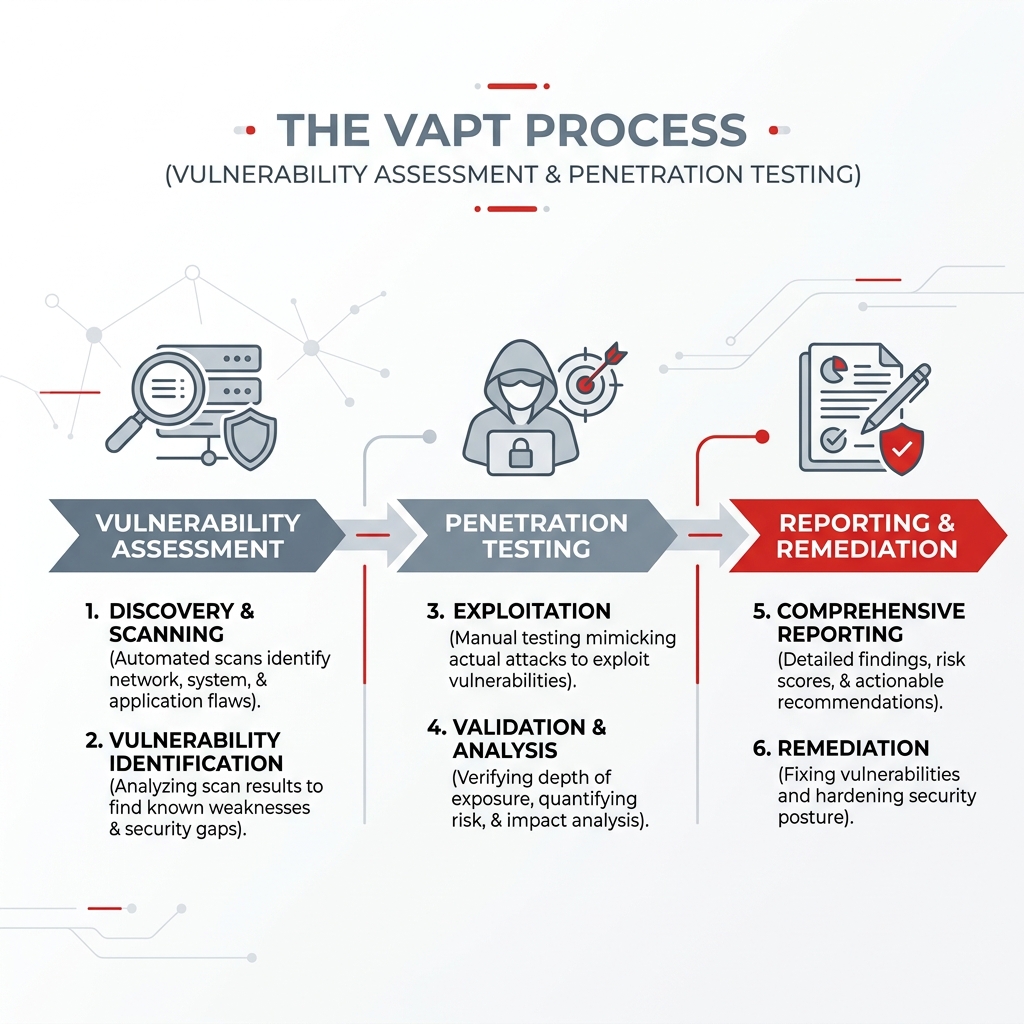
The VAPT Process
A professional VAPT engagement generally follows these stages:
1. Scoping
Define:
- Assets to be tested
- Testing objectives
- Assessment boundaries
- Compliance requirements
2. Information Gathering
Security experts collect information about systems, applications, and infrastructure.
3. Vulnerability Discovery
Automated and manual testing techniques identify potential security weaknesses.
4. Exploitation
Ethical hackers validate vulnerabilities through controlled exploitation.
5. Risk Analysis
Each finding is analyzed based on:
- Severity
- Impact
- Exploitability
- Business Risk
6. Reporting
A detailed report provides:
- Vulnerability details
- Risk ratings
- Proof of concept
- Remediation recommendations
7. Retesting
After fixes are implemented, vulnerabilities are retested to confirm successful remediation.
Common Vulnerabilities Found During VAPT
Some frequently discovered issues include:
- Weak Password Policies
- Unpatched Software
- SQL Injection
- Cross-Site Scripting (XSS)
- Insecure APIs
- Misconfigured Firewalls
- Open Ports
- Privilege Escalation
- Broken Access Controls
- Sensitive Data Exposure
These vulnerabilities can provide attackers with opportunities to compromise systems if left unaddressed.
How Often Should Organizations Perform VAPT?
Security experts recommend conducting VAPT:
- Annually at minimum
- After major infrastructure changes
- Before product launches
- Following application updates
- After mergers or acquisitions
- To meet compliance requirements
Cybersecurity is not a one-time activity. Continuous testing helps organizations stay ahead of evolving threats.
Best Practices for Effective VAPT
To maximize the value of VAPT:
- Define Clear Objectives: Understand what assets require protection and prioritize critical systems.
- Test All Critical Assets: Include Web Applications, Mobile Applications, APIs, Networks, Cloud Infrastructure.
- Prioritize Remediation: Address high-risk vulnerabilities first.
- Retest After Fixes: Validate remediation efforts through retesting.
- Make VAPT Continuous: Regular testing provides ongoing visibility into emerging security risks.
Final Thoughts
Cyber threats continue to grow in sophistication, making proactive security testing a necessity rather than an option. Vulnerability Assessment and Penetration Testing (VAPT) helps organizations identify weaknesses, validate security controls, meet compliance requirements, and reduce cyber risk.
Whether you're a startup, enterprise, SaaS provider, fintech company, healthcare organization, or e-commerce business, regular VAPT assessments can significantly improve your cybersecurity posture and protect your most valuable digital assets.
Ready to Secure Your Infrastructure?
Looking for professional VAPT services?
Partner with experienced cybersecurity experts to identify vulnerabilities before attackers do. Regular VAPT assessments help secure your applications, networks, cloud environments, and business-critical systems.
Start your security assessment today and strengthen your cyber defenses before the next attack.